



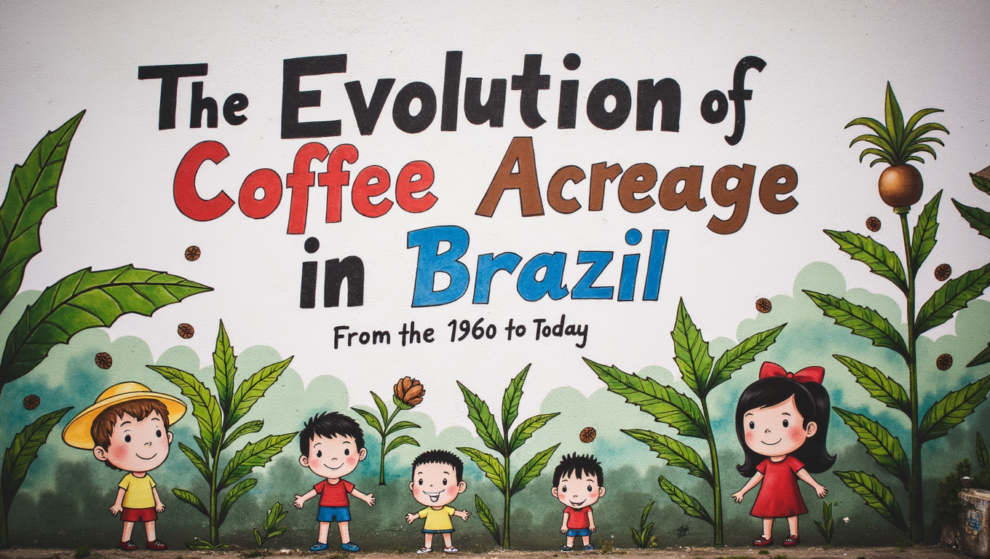


The evolution of coffee acreage in Brazil reflects the country’s dynamic agricultural development and its position as the world’s leading coffee producer. In the 1960s, Brazil’s coffee farms were relatively concentrated in the southeastern states, primarily Minas Gerais, São Paulo, and Espírito Santo. During this period, coffee cultivation was largely traditional, with smallholders relying on manual labor and limited mechanization. Acreage expansion was gradual, driven mainly by domestic demand and the beginnings of large-scale export orientation.
During the 1970s and 1980s, Brazil witnessed a significant increase in coffee acreage, fueled by government incentives, improved infrastructure, and advancements in agricultural research. New regions such as the Cerrado Mineiro in Minas Gerais and parts of Goiás saw large-scale mechanized plantations emerge, taking advantage of flatter terrain and better soil management practices. These decades also marked the introduction of higher-yielding Arabica varieties and the expansion of Robusta (Conilon) coffee in the northern states, particularly Espírito Santo, helping Brazil diversify its production.
From the 1990s to the early 2000s, coffee acreage growth slowed in some traditional regions due to urbanization, rising land prices, and environmental constraints. Many smallholders either reduced their coffee areas or switched to alternative crops. However, technological innovations, such as precision planting, improved irrigation, and disease-resistant coffee varieties, allowed farmers to increase productivity on existing land rather than expanding acreage. This period also saw consolidation in the industry, with larger farms becoming more dominant.
In recent years, coffee acreage in Brazil has stabilized, with a focus on efficiency, sustainability, and quality rather than sheer expansion. New plantings are carefully planned to optimize altitude, soil conditions, and climate suitability. Regions like Cerrado Mineiro, Sul de Minas, and Mogiana continue to dominate Arabica production, while Espírito Santo remains the hub for Robusta. Moreover, environmental regulations and certification programs have encouraged reforestation and responsible land use, influencing the way acreage is managed.
Overall, the evolution of coffee acreage in Brazil illustrates a transition from expansive growth to a more strategic and sustainable approach. While the total area under coffee has seen fluctuations due to economic, environmental, and social factors, Brazil’s commitment to innovation and quality ensures that it continues to lead global coffee production. The trajectory of acreage reflects not only the country’s agricultural history but also its adaptation to modern challenges and global market demands.