




Brazil’s coffee industry is defined not only by massive corporate plantations but also by large family-owned farms that balance tradition with modern efficiency. Semi-mechanized large family farms have emerged as a vital segment in this landscape, combining hands-on family management with strategic mechanization to enhance production while maintaining quality and sustainability.
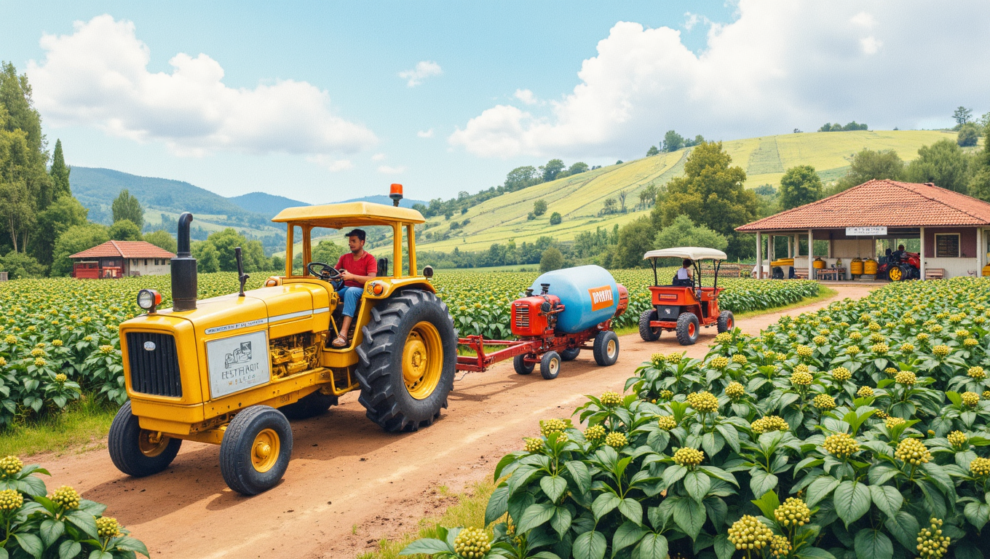
Semi-mechanization typically involves using machinery for labor-intensive tasks such as harvesting, pruning, and soil preparation, while retaining manual intervention for delicate processes like selective picking and quality control. This hybrid approach allows family farms to scale their production beyond what purely manual labor permits, without losing the nuanced care that characterizes high-quality coffee.
Efficiency gains from semi-mechanization are significant. By deploying mechanized harvesters or pruning equipment on flatter terrains, farms can cover larger areas with fewer laborers, reducing seasonal labor bottlenecks and minimizing production costs. At the same time, families maintain control over quality-critical steps, ensuring that beans meet both domestic and international market standards.
Moreover, semi-mechanized large family farms often implement advanced management practices such as precision irrigation, soil fertility monitoring, and integrated pest management. These tools further optimize yield and reduce waste, creating a balance between environmental stewardship and economic viability. Such farms also serve as a bridge between smallholder traditions and large-scale industrial production, offering models of scalable efficiency that remain rooted in family ownership.
In conclusion, semi-mechanized large family farms represent a crucial evolution in Brazilian coffee production. By integrating machinery where it counts while preserving manual expertise for quality-sensitive tasks, these farms optimize both efficiency and product excellence. They exemplify how family-run operations can thrive in a competitive global market, contributing to Brazil’s status as the world’s leading coffee producer.