







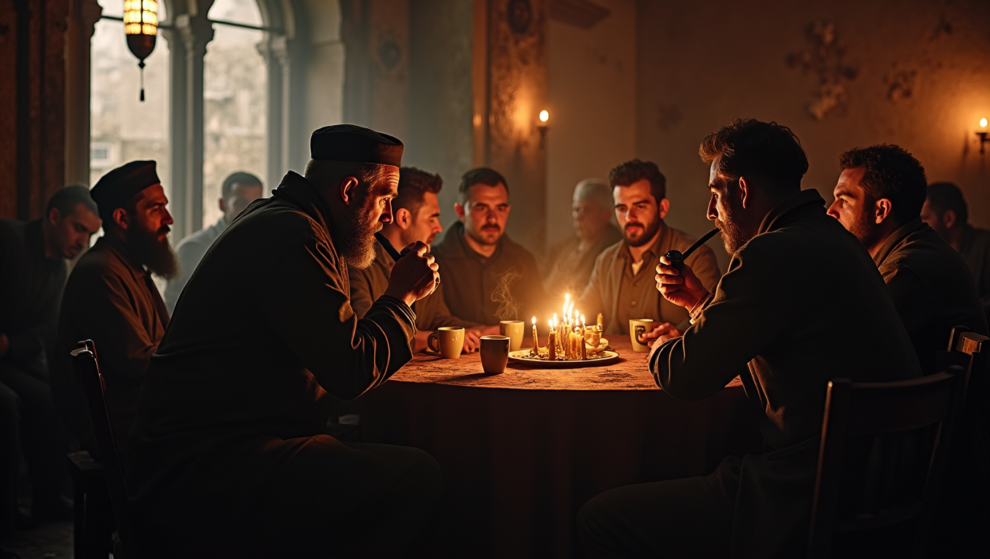


From the moment coffeehouses appeared in Ottoman cities, they stood at the uneasy border between public desire and state authority. Laws were written against them, doors were sealed, and cups were smashed—yet coffeehouses endured. Their survival was not accidental; it was the result of a quiet, persistent resistance rooted in everyday habit rather than open rebellion.
Official opposition to coffeehouses often stemmed from fear. These spaces gathered men of different professions, classes, and opinions under one roof. Conversation flowed freely, stories turned into critiques, and satire slipped easily into political commentary. To authorities, the coffeehouse was not just a place to drink—it was a site of unsupervised speech. Closing them seemed a logical way to silence the noise. Yet enforcement rarely matched intention. When coffeehouses were banned, they simply changed form. Some reopened as shops selling “roasted beans” or “warm drinks,” others operated behind partially closed shutters, while many moved into private homes. Coffee itself never disappeared; it slipped through alleys, back rooms, and domestic spaces. The law, heavy on paper, grew light in practice.
Public resistance was subtle but powerful. There were no marches, no manifestos—only persistence. Customers returned again and again, rebuilding routines as soon as restrictions loosened. Coffeehouse owners, aware of both risk and demand, negotiated with officials, paid fines, or shifted locations. This was resistance by adaptation, not confrontation.
Economic reality further weakened authority. Coffeehouses supported a wide network of workers—roasters, grinders, porters, cup makers, water carriers. Closing coffeehouses disrupted livelihoods and reduced taxable activity. Over time, the state recognized that repression caused more loss than control. The public did not argue against the law; it outlasted it.
Equally important was coffee’s role in social life. Coffeehouses had become extensions of the street and the home—a third space where news was exchanged, disputes settled, and loneliness eased. To remove them was to remove a shared rhythm of urban life. Laws could be issued, but they could not erase memory or habit.
By the time prohibitions faded, coffeehouses reemerged not as rebels but as institutions. Their persistence reshaped authority itself. The state shifted from suppression to regulation, licensing coffeehouses rather than erasing them, monitoring conversation rather than silencing it.
In the end, coffeehouses survived the law because they were sustained by collective need. Authority ruled through decrees; the public ruled through routine. Between the two, it was habit that proved stronger.
Coffeehouses have long stood at the intersection of culture, commerce, and conversation. Across centuries, they became places where ideas circulated as freely as coffee itself. The story of how cafés endured regulation, censorship, and shifting political priorities forms a remarkable chapter in global social history. The narrative known as Coffeehouses Survive the Law history reveals not only the resilience of business owners but also the powerful bond between coffee and community life.
The rise of organized coffee drinking began during the expansion of the Ottoman Empire, where cafés quickly became central gathering points. Scholars examining Coffeehouses Survive the Law Ottoman cafés often describe these establishments as early public forums. Merchants discussed trade routes, poets shared verses, and travelers exchanged news from distant provinces. Coffeehouses helped shape urban identity, yet their influence also attracted government scrutiny.
Authorities soon realized that coffeehouses encouraged debate and sometimes dissent. Through Coffeehouses Survive the Law coffeehouse regulation, rulers attempted to monitor conversations and gatherings. Officials feared that unchecked discussion might lead to political unrest. The emergence of Coffeehouses Survive the Law legal coffee culture demonstrates how lawmakers struggled to balance economic benefits with concerns about public order.
Historical records show repeated attempts to restrict cafés. During periods of instability, leaders imposed strict controls that shaped Coffeehouses Survive the Law café survival history. Some rulers viewed coffeehouses as breeding grounds for criticism. These anxieties resulted in Coffeehouses Survive the Law government restrictions cafés, including surveillance, curfews, and licensing requirements designed to regulate patrons and owners alike.
One of the most dramatic examples occurred during the reign of Murad IV, when coffee consumption faced severe crackdowns. Episodes associated with Coffeehouses Survive the Law historical coffee bans demonstrate how authorities occasionally outlawed cafés entirely. Despite harsh penalties, enforcement proved difficult. Coffee drinking had already woven itself into daily routines, making prohibition unpopular and largely ineffective.
The persistence of café owners highlights the long-term Coffeehouses Survive the Law coffeehouse legislation impact. Entrepreneurs adapted quickly by relocating shops, operating discreetly, or cooperating with inspectors. Their ingenuity shaped a unique Coffeehouses Survive the Law café resistance culture, where survival depended on flexibility rather than confrontation.
Coffeehouses were not merely commercial enterprises; they preserved traditions. Through storytelling, music, and shared rituals, they nurtured Coffeehouses Survive the Law coffee social traditions. Observers described patrons gathering to play games, listen to scholars, or debate philosophy. These practices contributed significantly to Coffeehouses Survive the Law Ottoman social life cafés, reinforcing cafés as essential institutions rather than optional luxuries.
Economic necessity also encouraged tolerance. Governments benefited from taxes and trade revenues connected to coffee imports. The reality of Coffeehouses Survive the Law coffeehouse economic survival demonstrated that banning cafés often harmed urban economies. Coffeehouses created employment for roasters, grinders, suppliers, and artisans, strengthening Coffeehouses Survive the Law café industry resilience even during restrictive periods.
Legal oversight extended beyond cafés themselves. Authorities introduced rules governing assembly and conversation, shaping Coffeehouses Survive the Law public gathering laws history. Officials attempted to limit crowd sizes or regulate operating hours. At the same time, international trade expanded rapidly, forcing administrators to consider Coffeehouses Survive the Law coffee trade regulation history as imported beans became increasingly valuable commodities.
Despite restrictions, ambitious entrepreneurs continued opening cafés. Their determination defined Coffeehouses Survive the Law café entrepreneurship survival. Many owners cultivated relationships with officials or complied with licensing systems to remain operational. Over time, these compromises influenced Coffeehouses Survive the Law coffeehouse reform policies, gradually transforming regulation into structured governance rather than outright suppression.
Urban growth further strengthened cafés’ position. Cities such as Istanbul became hubs of intellectual exchange where travelers encountered diverse perspectives. Within this environment emerged Coffeehouses Survive the Law urban café culture history, illustrating how cafés helped shape cosmopolitan identities. Networks of suppliers and patrons connected neighborhoods, forming Coffeehouses Survive the Law traditional coffeehouse networks that supported both commerce and culture.
Licensing systems became increasingly sophisticated. Officials introduced inspections, fees, and operational standards that formed the basis of Coffeehouses Survive the Law café licensing history. While these measures restricted independence, they also legitimized cafés as recognized businesses. Regulation unintentionally strengthened their permanence within urban economies.
Political authorities remained cautious because cafés influenced public opinion. Discussions held over steaming cups often addressed taxation, military campaigns, or leadership decisions. Such conversations defined Coffeehouses Survive the Law coffeehouse political influence, making cafés informal arenas of civic participation. At the same time, patrons valued them as inclusive meeting grounds, reinforcing their importance as Coffeehouses Survive the Law café community spaces.
Economic historians emphasize how cafés stimulated broader markets. Suppliers transported beans across deserts and seas, grinders processed them locally, and servers prepared beverages for diverse customers. This interconnected activity contributed to Coffeehouses Survive the Law historic café economy, demonstrating why governments ultimately chose regulation over eradication.
Beyond economics, cafés protected cultural memory. Storytellers, musicians, and scholars preserved traditions through performance and conversation. These practices embodied Coffeehouses Survive the Law coffeehouse cultural heritage, ensuring that oral histories and artistic expression survived even during political tension. Owners adjusted décor, menus, or seating arrangements as part of Coffeehouses Survive the Law café business adaptation, responding creatively to legal expectations.
Legal systems themselves evolved alongside coffee culture. Administrators recognized that excessive prohibition encouraged illegal operations. Consequently, policymakers introduced gradual reforms reflected in Coffeehouses Survive the Law coffeehouse legal reforms. Regulations shifted toward taxation, licensing, and quality control rather than outright bans.
These developments illustrate broader patterns of endurance. The ability of cafés to persist during changing leadership defined Coffeehouses Survive the Law café resilience Ottoman era. Coffeehouses survived wars, economic downturns, and ideological debates because communities depended on them for connection and information.
Observers also documented how cafés shaped literacy and education. Newspapers circulated among patrons, and scholars held informal lectures. Such activities contributed to Coffeehouses Survive the Law historical public café culture, turning ordinary shops into centers of learning. Authorities occasionally attempted censorship, yet enforcement rarely eliminated conversation entirely.
Administrative records reveal detailed supervision mechanisms. Inspectors monitored prices, cleanliness, and operations, forming early examples of Coffeehouses Survive the Law coffeehouse governance history. Governments aimed to maintain order while benefiting from taxable commerce. This delicate balance encouraged cooperation between officials and café owners.
Adaptation remained the key to longevity. Some cafés diversified services by offering food, entertainment, or meeting rooms. Others cultivated loyal clientele who supported them during difficult times. These innovative responses shaped Coffeehouses Survive the Law café survival strategies, proving that resilience often depended on creativity rather than resistance alone.
Another important factor was coffee’s universal appeal. Unlike elite dining halls, coffeehouses welcomed individuals from multiple social classes. Merchants sat beside craftsmen, travelers beside scholars. This inclusivity strengthened loyalty among patrons and discouraged permanent closures. Authorities discovered that suppressing cafés risked alienating large segments of society.
Trade expansion also influenced legal attitudes. As coffee demand grew across Europe and Asia, governments recognized the strategic importance of maintaining supply chains. Regulation ensured consistent quality and reliable taxation revenue. Coffeehouses therefore became symbols of controlled prosperity rather than uncontrolled dissent.
Cultural diplomacy played a subtle role as well. Visiting diplomats frequently attended cafés to observe local customs and gather information. These encounters showcased hospitality traditions and demonstrated the sophistication of urban life. By the eighteenth century, cafés were no longer experimental spaces but established institutions woven into daily routines.
The endurance of cafés ultimately reflects the adaptability of both businesses and governments. While rulers attempted oversight through bans, licenses, or surveillance, communities continually reaffirmed their attachment to shared coffee rituals. The tension between authority and social life produced reforms that allowed cafés to flourish within legal frameworks.
Today, historians studying Coffeehouses Survive the Law history recognize that regulation did not destroy café culture; instead, it shaped its evolution. From early suspicion to eventual acceptance, authorities learned that conversation could not easily be legislated away. Coffeehouses survived because they fulfilled essential human needs — communication, companionship, and creativity.
The legacy of Coffeehouses Survive the Law Ottoman cafés reminds modern readers that public gathering spaces often endure beyond political change. Through innovation, negotiation, and cultural importance, cafés transformed restrictions into opportunities for growth. Their story demonstrates how commerce and community can adapt together, ensuring that even under strict laws, the aroma of coffee — and the conversations surrounding it — continues to thrive across generations.