







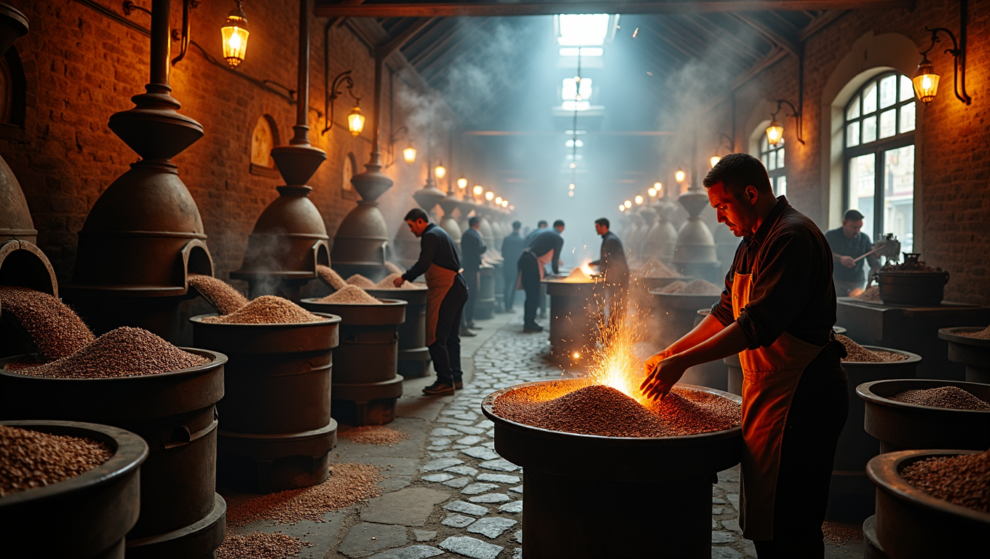


Before coffee ever reached a porcelain cup, before it darkened lips and sharpened conversation, it passed through a place of thunder. In the heart of Ottoman Istanbul stood the tahmishane—the official roasting and grinding house—where coffee was transformed from a silent green bean into the city’s most audible obsession. Among them, the largest tahmishane was not merely a workshop, but a living machine whose rhythm echoed through nearby streets.
At dawn, its heavy doors opened to a tide of labor. Vast roasting pans were set over steady fires, and beans imported from Yemen were stirred endlessly to ensure even color and aroma. The air thickened with smoke and fragrance, drifting across markets and alleyways, announcing that the city’s day had begun. For many Istanbulites, the smell of roasting coffee was as reliable as the call to prayer—an invisible clock regulating urban life.
Inside, the true thunder came from the mortars. Enormous stone basins, worn smooth by years of use, held roasted beans that were crushed by long wooden pestles. Workers lifted and dropped them in practiced unison, producing a deep, rolling sound that gave the tahmishane its voice. This was no accidental noise; it was the soundtrack of regulation. Every blow marked coffee passing through state-sanctioned hands, measurable, taxable, and controlled.
The tahmishane was also a space of order. Scales stood ready, weights standardized, and overseers watched carefully for waste or theft. Unlike the secrecy of smuggling or the intimacy of home roasting, everything here was visible. Coffeehouse owners arrived with sacks to be filled, knowing that only coffee processed within these walls could be legally sold. Flavor, texture, and fineness were thus quietly standardized, shaping how an entire city tasted its coffee.
Yet despite its official character, the tahmishane was not lifeless. Conversations flowed among workers, gossip moved as quickly as beans, and news traveled outward with each departing sack. In this way, the tahmishane mirrored the coffeehouse itself—another place where labor, talk, and routine blended. The thunder of the mortars did not silence voices; it carried them.
By midday, the work reached its peak. Sweat darkened tunics, fires glowed relentlessly, and the pounding never ceased. The building seemed to breathe—inhale beans, exhale aroma, pulse with sound. What emerged was more than ground coffee. It was the regulated energy of the city, prepared for distribution to countless cups and conversations.
In time, the tahmishane became a symbol of the state’s accommodation with coffee. No longer an object of bans and suspicion, coffee had earned a permanent place in urban life—so long as it passed through official channels. The thunder in the mortars was the sound of compromise: between desire and authority, habit and law.
Thus, inside Istanbul’s largest tahmishane, one hears more than noise. One hears the city learning how to live with its addictions—not by silencing them, but by giving them walls, rules, and a rhythm.
Coffee shaped cities long before modern cafés existed, and nowhere was this transformation more dramatic than in the bustling capital of the Ottoman Empire. Behind the aroma drifting through markets and coffeehouses stood enormous grinding workshops known as tahmishanes. These industrial centers powered commerce and culture alike. The story captured in Thunder in the Mortars coffee history reveals how sound, labor, and craftsmanship combined to create one of the earliest organized coffee industries in the world.
The Rise of the Great Tahmishane
At the center of this narrative stands Thunder in the Mortars Istanbul Tahmishane, a massive grinding complex whose daily operations echoed through nearby streets. The rhythmic pounding of mortars and turning of grinding stones produced a constant thunder-like sound, giving rise to descriptions that survive in historical accounts.
As coffee consumption expanded rapidly during the sixteenth and seventeenth centuries, authorities recognized the need for centralized production. Small household grinding methods could not support urban demand. The emergence of large-scale facilities marked a turning point in Thunder in the Mortars Tahmishane history, transforming coffee preparation into organized industry.
These facilities represented the backbone of Thunder in the Mortars Ottoman coffee industry, connecting imported beans to cafés and households across the city.
Grinding Houses as Industrial Powerhouses
The importance of the Thunder in the Mortars coffee grinding house cannot be overstated. Workers operated massive stone mills capable of processing large quantities of roasted beans daily. Grinding required precision because traditional brewing demanded extremely fine powder.
The sound generated by continuous grinding became symbolic of productivity. Observers described streets vibrating with activity, reinforcing the imagery associated with Thunder in the Mortars traditional coffee grinding.
Many of these workshops functioned as Thunder in the Mortars coffee production centers, employing grinders, carriers, roasters, accountants, and inspectors. Their organization resembled early factories long before industrialization transformed Europe.
Coffee Culture and Urban Identity
Coffee quickly became part of daily life in imperial cities. The expansion of grinding houses supported Thunder in the Mortars Ottoman coffee culture, allowing cafés to flourish as centers of storytelling and debate.
In the bustling districts of Istanbul, citizens gathered to discuss literature, politics, and trade over steaming cups. This environment strengthened Thunder in the Mortars Ottoman café culture, where coffeehouses served as informal universities and news exchanges.
Grinding houses allowed café owners to focus on hospitality rather than preparation logistics. Reliable supply chains encouraged creativity in serving styles and presentation, shaping early hospitality traditions.
Trade Routes and Economic Influence
Coffee beans traveled vast distances before reaching tahmishanes. Imported largely from regions such as Yemen, shipments arrived through maritime routes before entering urban markets.
The coordination required for distribution formed the foundation of Thunder in the Mortars Ottoman coffee trade. Merchants collaborated with port officials, warehouse managers, and transport workers to maintain steady flow.
This structure contributed significantly to the Thunder in the Mortars Tahmishane coffee economy. Taxes collected at each stage generated revenue while encouraging oversight of quality and pricing.
Through these networks, tahmishanes became central nodes within expanding Thunder in the Mortars coffee supply chain history, linking farms, ships, markets, and cafés into a single commercial system.
Craftsmanship Behind the Thunder
Grinding coffee was not merely mechanical labor. Skilled artisans carefully monitored pressure, timing, and equipment wear. Their expertise defined Thunder in the Mortars coffee craftsmanship.
Masters trained apprentices to recognize the perfect texture required for brewing. Too coarse a grind weakened flavor; too fine could damage brewing vessels. Such attention to detail elevated grinding into an art form.
These specialists formed the heart of Thunder in the Mortars coffee artisans Ottoman era, passing techniques across generations. Their knowledge preserved consistency throughout the empire’s expanding coffee markets.
Alongside grinding, roasting traditions flourished. The careful turning of beans over charcoal fires shaped the Thunder in the Mortars coffee roasting tradition, ensuring aroma and flavor met consumer expectations.
Historical Mills and Production Technology
Many tahmishanes operated as monumental workshops filled with enormous stone mortars and heavy grinding wheels. These machines defined Thunder in the Mortars historical coffee mills, representing impressive engineering achievements for their time.
Workers often labored in shifts to maintain continuous production. Animal power or manual rotation drove grinding equipment, demonstrating innovative solutions long before steam engines appeared.
Efficiency improvements contributed to Thunder in the Mortars historical coffee production, allowing cities to support growing populations dependent on daily coffee consumption.
Advancements in storage containers and roasting pans also improved preservation, strengthening commercial reliability.
Turkish Coffee Preparation and Specialty Origins
Once ground, coffee moved quickly into kitchens and cafés where brewing traditions flourished. The finely powdered beans enabled slow heating techniques essential for foam development and aroma.
These practices defined Thunder in the Mortars Turkish coffee preparation, emphasizing patience and ritual. The resulting beverage differed significantly from later filter methods popular elsewhere.
Experimentation among roasters encouraged early examples of Thunder in the Mortars specialty coffee origins. Blends varied depending on roasting intensity or bean source, attracting loyal customers seeking distinctive flavor profiles.
This experimentation supported Thunder in the Mortars authentic Turkish coffee culture, blending craftsmanship with hospitality traditions.
Social Meaning and Cultural Influence
Coffeehouses influenced more than taste; they shaped society itself. Conversations forged friendships, business agreements, and artistic collaborations. The availability of reliable ground coffee strengthened Thunder in the Mortars cultural coffee significance.
Serving coffee symbolized generosity and respect. Families welcomed guests with carefully prepared cups, reinforcing traditions linked to hospitality and honor.
Such rituals encouraged the growth of Thunder in the Mortars traditional coffee houses, where music, poetry, and storytelling became part of everyday life.
The social impact extended into governance as well. Authorities monitored gatherings, recognizing cafés as powerful centers of public opinion.
Market Expansion and Entrepreneurship
As demand expanded, entrepreneurs recognized opportunities within regulated systems. Investment in roasting equipment and distribution routes encouraged Thunder in the Mortars Ottoman entrepreneurship coffee.
Merchants competed through quality improvements and efficient delivery rather than uncontrolled expansion. These innovations supported Thunder in the Mortars coffee market development, strengthening both local economies and international trade.
Growing exports and imports connected imperial markets to Europe and beyond. Expanding Thunder in the Mortars coffee trade networks introduced coffee culture to new regions, shaping global consumption patterns.
Large-scale operations also influenced pricing stability, helping prevent shortages that could disrupt urban life.
Urban Soundscape and Everyday Life
The thunderous grinding that defined tahmishanes shaped the sensory identity of the city itself. Residents recognized the rhythm of production as a sign of prosperity.
This atmosphere formed part of Thunder in the Mortars urban coffee life Istanbul, where commerce, labor, and culture blended seamlessly. Markets opened alongside grinding workshops, and café owners waited for fresh deliveries each morning.
The noise symbolized productivity, reminding citizens that thousands of cups depended on coordinated effort behind the scenes.
Legacy of the Coffee Heritage Industry
Today, historians recognize these grinding houses as pillars of the Thunder in the Mortars coffee heritage industry. Their influence extends into modern specialty coffee movements emphasizing origin transparency and craftsmanship.
Modern cafés still rely on centralized roasting and grinding facilities, echoing practices developed centuries ago. The relationship between production and community remains remarkably similar.
Preserved buildings and historical records help scholars understand how organized processing shaped global coffee habits.
Conclusion
The narrative captured in Thunder in the Mortars coffee history reveals how industrial innovation and cultural tradition grew together. Massive grinding houses transformed imported beans into daily ritual, supporting the rise of vibrant café culture and expanding trade networks.
From the precision of Thunder in the Mortars coffee grinding techniques to the creativity of Thunder in the Mortars Ottoman café culture, tahmishanes represented far more than workshops. They powered economies, influenced social life, and connected distant farmers to urban conversations.
Ultimately, the thunder heard within these mortars symbolized progress. Through craftsmanship, entrepreneurship, and careful organization, they shaped the enduring legacy of coffee as both industry and shared human experience.