







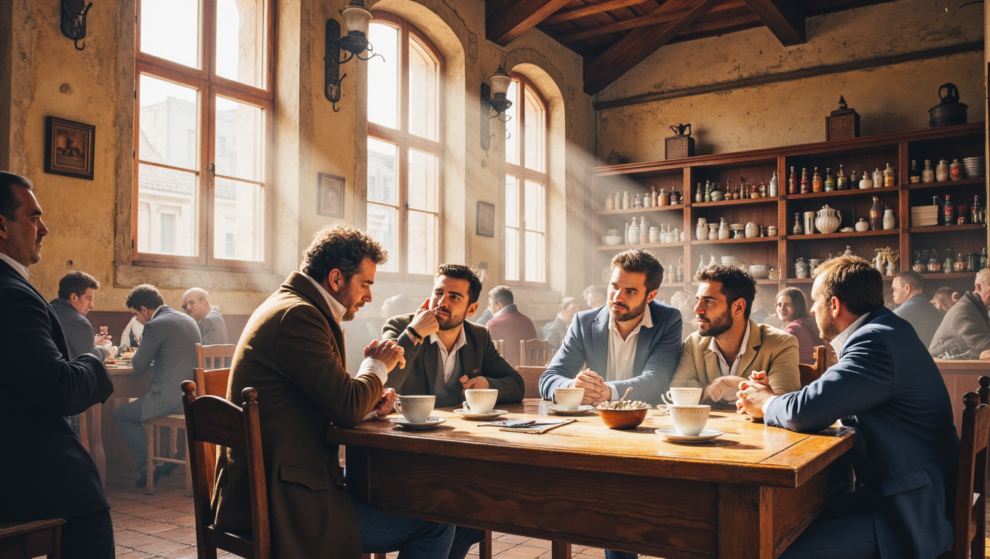


Coffee entered Spain not merely as a beverage but as a quiet catalyst of intellectual change during the 18th century, the era known as the Spanish Enlightenment (La Ilustración). As Enlightenment ideas spread across Europe, coffeehouses emerged as new social spaces where conversation, reading, and debate could flourish. Unlike taverns dominated by alcohol, coffee offered clarity of mind, making it an ideal companion for rational thought. In cities such as Madrid, Cádiz, and Barcelona, coffeehouses became gathering places for writers, reformers, and curious citizens eager to engage with modern ideas.
During this period, Spain was opening itself—slowly but decisively—to scientific reasoning, secular education, and administrative reform. Coffeehouses provided an informal extension of academies and salons, where newspapers, pamphlets, and translated works from France and Britain were shared. Intellectuals discussed astronomy, economics, philosophy, and political theory over cups of strong coffee. The drink symbolized alertness and modernity, aligning perfectly with Enlightenment values of reason, observation, and progress.
The Bourbon reforms of the 18th century further strengthened coffee’s role in Spanish intellectual life. As trade expanded with the Americas, coffee became more accessible and affordable, especially in port cities like Cádiz, a hub of transatlantic commerce. Imported coffee from Caribbean and Latin American colonies helped normalize daily consumption, transforming coffee from a luxury into a cultural habit. This accessibility allowed broader segments of society—merchants, students, and professionals—to participate in the coffeehouse culture of discussion and exchange.
Coffee also influenced literary and journalistic activity in Enlightenment Spain. Early periodicals and gazettes were often read and debated in cafés, helping spread new ideas beyond elite circles. Writers and satirists observed café life as a microcosm of society, where tradition met innovation. Coffeehouses became places where criticism of superstition, advocacy for education, and calls for social reform could circulate with relative freedom, even under censorship.
By the end of the Spanish Enlightenment, coffee had firmly established itself as more than a drink—it was a symbol of intellectual awakening. It accompanied Spain’s gradual shift toward scientific inquiry, public debate, and cultural modernisation. Though quieter than revolutions elsewhere in Europe, Spain’s Enlightenment found in coffee a steady companion, fuelling minds, conversations, and the slow but meaningful transformation of society.