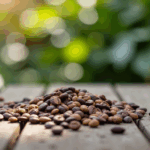
Arabica beans are considered the highest-quality coffee beans in the world, known for their smooth, rich, and naturally sweet flavour. They grow best in high-altitude regions with cooler temperatures, which allows the cherries to develop slowly. This slow growth creates deeper, more complex taste notes such as chocolate, caramel, nuts, berries, or even floral hints. Because of their delicate structure, Arabica plants require more care and attention, making the beans more valuable and often more expensive. Arabica beans are grown in high-altitude, tropical regions that have mild temperatures, regular rainfall, and rich soil. These conditions help the beans develop slowly and gain their smooth, complex flavour. Countries are Brazil, Colombia, Ethiopia, Kenya, Costa Rica, Guatemala, Honduras, India, Indonesia, Yemen. Arabica gets its name from this region. Historically, Yemen was one of the earliest exporters of Arabica coffee.
“The beauty of Coffea arabica lies in its delicate balance—smooth flavor, gentle aroma, and the quiet elegance of nature in every bean.”
The name “Arabica” was not given by a single person; it comes from the Arabian Peninsula, especially Yemen, where the coffee plant was first grown on a large scale and traded across the world. Early traders and botanists named it Coffea arabica because the beans became widely known through Arab merchants and markets. As coffee spread from Ethiopia to Yemen and then to the rest of the world through Arabian trade routes, the plant naturally took on a name that reflected its strong connection to the Arab region.
Arabica beans turn every cup into a journey of smooth, rich, and delicate flavors.”
What makes Arabica special is its gentle acidity and pleasant aroma, which give the coffee a clean and balanced taste. Unlike stronger and more bitter Robusta beans, Arabica offers a softer, more refined experience that many coffee lovers prefer. Most speciality cafés and high-quality blends use Arabica beans to ensure a smooth, enjoyable cup. Whether brewed as espresso, Americano, or black coffee, Arabica brings out a comforting flavour that feels both elegant and satisfying.
“Great coffee begins with great beans, and few are more cherished than Coffea arabica, known for its rich taste and refined character.”
Coffea arabica is special because it produces coffee with a naturally smooth, rich, and complex flavor that many people prefer over other bean types. It grows at higher altitudes, which allows the cherries to develop slowly and create sweet, delicate notes like chocolate, caramel, fruit, or flowers. Arabica also has a gentle acidity and pleasant aroma that make each cup feel refined and balanced. Because the plant is more sensitive and harder to grow, the beans are often treated with extra care, resulting in premium quality coffee enjoyed in cafés and homes around the world.
Coffea arabica beans contain a rich mix of natural chemicals that create their smooth flavour and pleasant aroma. They have less caffeinethan Robusta, usually around 1–1.5%, which gives Arabica a softer taste. They also contain chlorogenic acids, antioxidants that influence acidity and brightness in the cup. Arabica beans are high in lipids (fats) and sugars, which help develop sweetness and complex flavours during roasting. Compounds like trigonelline, proteins, and volatile aromatic molecules contribute to aromas such as fruity, floral, nutty, or chocolatey notes. Together, these chemical components make Arabica coffee naturally rich, balanced, and enjoyable.
History
By the 15th century, Arabica coffee spread across the Arabian Peninsula, especially Yemen. There, the beans were first roasted and brewed in a way similar to modern coffee. Yemen’s port city of Mocha became the earliest global coffee trading hub, giving the world the word “mocha.” Coffee houses—called qahveh khaneh—became important cultural centres for conversation, music, and learning.
In the 17th century, Arabica plants were smuggled or gifted to other regions, eventually reaching Europe, India, and Southeast Asia. The Dutch played a major role in transporting the plants to Java (Indonesia), and from there Arabica cultivation spread across tropical regions. Later, Arabica reached the Caribbean and Latin America, where countries like Brazil, Colombia, and Costa Rica eventually became massive producers. Today, Arabica is celebrated for its smoother, sweeter, more aromatic flavour compared to other coffee species. Its long global journey—from Ethiopia to Yemen to the rest of the world—shaped the entire history of coffee culture.